
Corporate Management
Corporate Culture
Externally: Uphold integrity and trustworthiness, keep all words for customers and partners.
Internally: Be accountable and honest, maintain order and discipline, control the quality of each and every procedure and product to ensure the customer safety.
Strategic Positioning:Rooted in Taiwan, with an eye on the international market.While pursuing profitability, we maintain a keen understanding of global trends in light weighting and the circular economy, balancing short-term and long-termdevelopment to strengthen our core competitive capabilities.
Technical R&D:We do not content ourselves with the status quo, and are and focused on the development of forward-looking technologies. Through continuous R&D investment, we optimize the low-carbon manufacturing process and ensure SAI’s technological leadership in the industry.
Safety First:We continue to uphold our commitment to safeguarding the safety of every user, with an uncompromising pursuit of quality. From raw materials to finished forgings, every step of the process complies with stringent international standards, ensuring a balance of high strength and lightweight design while maintaining product quality.
Cornerstone of Trust:We are committed to providing high-quality services and consistent quality, with customer satisfaction at the core of what we do. High quality is not merely a commitment reflected in our products, but the cornerstone of earning the long-term trust of customers worldwide.
Mutual Prosperity to All: We uphold the spirit of “mutual prosperity” by strengthening cross-departmental collaboration, leveraging team synergies, and building close partnerships with customers and suppliers to jointly drive industrial advancement.
Shared Value: Through teamwork, we share our achievements, build trust with stakeholders, and co-create a sustainable future.
Organization
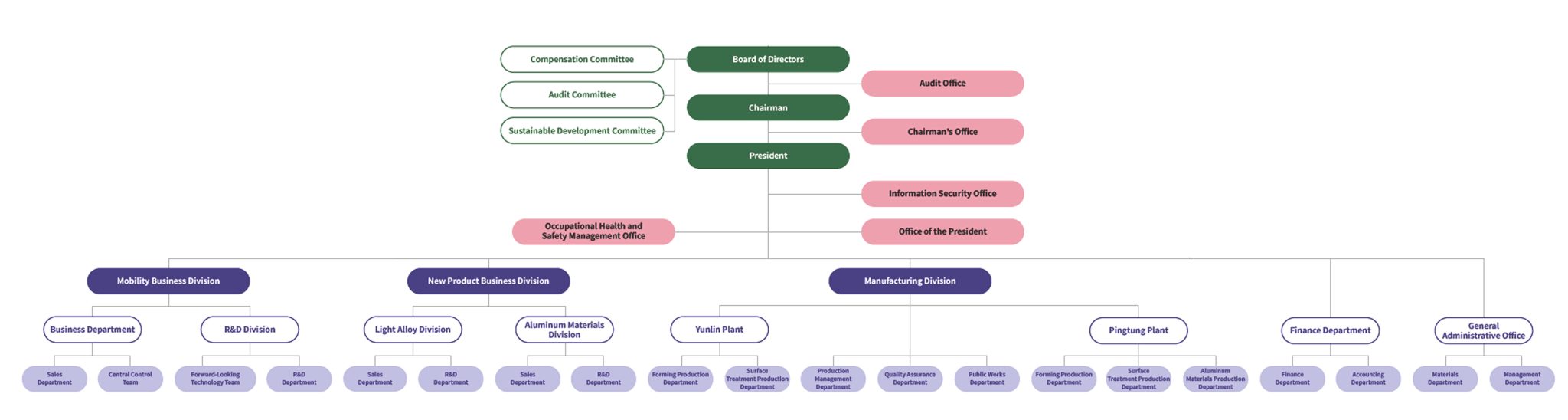
Board of Directors
Board of Directors
To maintain business ethics and integrity and ensure ethical behavior, we have established the “Procedures for Ethical Management and Guidelines for Conduct” and “Corporate Social Responsibility Best-Practice Principles” in accordance with the Ethical Corporate Management Best-Practice Principles for TWSE/GTSM Listed Companies and the relevant laws and regulations of the locations where the Company and affiliates are operated to stipulate the matters required for employee notification in business activities. The “Procedures for Ethical Management and Guidelines for Conduct” is also established to ensure that employees will not, either directly or indirectly, offer, accept, promise, or request for any undue advantages, or engage in other behavior against integrity, the law, or the trust obligation to gain or maintain personal profit in business operations.
To prevent unethical conduct and implement governance assessments, SAI has established a conflict of interest avoidance mechanism for the Board of Directors: Directors who have a personal interest or represent a corporate entity with an interest in any board proposal must state the key contents of their interest at the board meeting; if such an interest poses a risk of harming the Company’s interests, they shall not participate in discussions or voting and must recuse themselves. No conflicts of interest requiring recusal occurred among directors during the current year.
Company personnel engaging in commercial transactions with external agents, suppliers, customers, or other business partners also strictly require counterparties not to engage in illegal practices. If any business partner or counterparty is found to be involved in unethical conduct, SAI will immediately terminate commercial interactions and blacklist them as an ineligible partner to enforce our ethical corporate management policy.
The major duties of the Board include: setting the direction for business operations, supervising operational performance, preventing conflicts of interest, and ensuring legal compliance, as well as risk validation and response to optimize corporate governance. In additional to maintaining the interest of shareholders, the Board will also take realizing the interest of stakeholders including employees, customers, suppliers, local communities, the government, and non-governmental organizations as the guiding principle.
The Board is formed with 10 directors, including 4 independent directors, of different professional backgrounds. The diversified expertise of directors covering finance, law, and industry benefits the Company’s decision-making and long-term strategy planning for operations. To strengthen the sustainable development framework, the Board established the Sustainable Development Committee and passed the articles of organization in June 2022. This is a milestone set by the Company’s highest governance body to ingrain “sustainable development.”
-
-
Major education attainments and experience
- Department of International Business, Feng Chia University.
- Vice President, Sanhosun Industry.
-
Concurrent duties at the Company or in other companies
- Chairperson, Jeng-Yi Business Management Consultant Co., Ltd.
-
Major education attainments and experience
-
-
Major education attainments and experience
- Chairman of the Board, SuperAlloy Industrial Co. Ltd.
- Department of Chemical Engineering, United Technology and Business School
-
Concurrent duties at the Company or in other companies
- President, PVI Chemical Co., Ltd.
- President, Chia-yi Investment Co., Ltd.
-
Major education attainments and experience
-
-
Major education attainments and experience
- Members of the Administrative Appeal Review Committee of Yunlin County Government/Members of the Anti-Corruption and Integrity Meeting of Yunlin County Government/Department of Law, National Taiwan University
-
Concurrent duties at the Company or in other companies
- Lawyer, City State Law Firm
-
Major education attainments and experience
-
-
Major education attainments and experience
- Junior Manager, Hua Nan Bank
- Department of International Business, Feng Chia University
-
Concurrent duties at the Company or in other companies
- N.A.
-
Major education attainments and experience
-
-
Major education attainments and experience
-
Concurrent duties at the Company or in other companies
-
Major education attainments and experience
-
-
Major education attainments and experience
-
Concurrent duties at the Company or in other companies
-
Major education attainments and experience
-
-
Major education attainments and experience
- President, National Cheng Chi University.
- Ph.D. in Accounting, University of Missouri, USA.
-
Concurrent duties at the Company or in other companies
- Independent Director, Hanns Touch Holdings Company
- Independent Director, Acepodia
- Adjunct Research Chair Professor, Department of Accounting, Chengchi University
-
Major education attainments and experience
-
-
Major education attainments and experience
- Chair Professor and Dean of Academic Affairs, National Tsing Hua University/President, Yuan Ze University/Ph.D. in Materials Science and Engineering, University of Illinois Urbana-Champaign
-
Concurrent duties at the Company or in other companies
- Director, Wu Ta-You Foundation/Director, TSMC Education and Culture Foundation
-
Major education attainments and experience
-
-
Major education attainments and experience
- Professor, School of Law, Soochow University
- Ph.D. in Law, Westfälische Wilhelms-Universität Münster
-
Concurrent duties at the Company or in other companies
- Independent Director, Celxpert Energy Corporation
- Distinguished Professor, School of Law, Soochow University
-
Major education attainments and experience
-
-
Major education attainments and experience
- Associate professor, Department of Chemical Engineering, National Cheng Kung University/Ph.D. in Chemistry, University of Houston
-
Concurrent duties at the Company or in other companies
- Associate professor, Department of Chemical Engineering, National Cheng Kung University
-
Major education attainments and experience
Board members are aged between 40 and 80 years.
Functional Committee
The Company established the Compensation Committee seated by three directors was established in December 2011 to enforce corporate governance and optimize the compensation system of directors and officers. The major duties of the Compensation Committee include assisting the Board in establishing and periodically reviewing and assessing the policy, system, standard, and structure of the salary and compensation for directors and officers. Independent Director SHIH Mao-Lin is the convener of the present Compensation Committee.
We established the Audit Committee seated for a term of three years by all independent directors in accordance with the Securities and Exchange Act in October 2017. The committee convener and meeting chair should be elected by all members. Independent Director CHENG Ding-Wang is the convener of the present Audit Committee.
To strengthen the corporate sustainability framework, the Board established the Sustainable Development Committee and approved its organizational charter in June 2022.
Chaired by the Chairman and comprising two independent directors with sustainability expertise, the Committee is tasked with steering SAI’s strategic direction and sustainability vision,
while guiding the Sustainable Development Promotion Team and functional departments in implementing sustainability targets.
Prior to the release of the annual Sustainability Report, the Committee reports on goal achievements to the Board of Directors at least once a year.
Legal Compliance
We correctly calculate taxes and pay them by the deadline printed in the tax return forms in compliance with the local tax affair laws and regulations and their legal spirit. We also keep track on the changes in the local and international tax affairs laws and regulations, assess their impacts in all aspects, and quickly draw up countermeasures. We also periodically disclose tax information though open channels, such as the annual report, to stakeholders to ensure information transparency. We maintain open and frank communication with national tax collection agencies, provide the practical viewpoints and opinions of the industry, and assist in improving the tax environment and system. Legal and transparent tax incentivization policies are used and deductions against the legal spirit are rejected. Our enterprise structure and transactions comply with the commercial substance, and no structure and transaction arrangements are made to reduce or only to reduce tax. Tax policies are plan and implemented to assess the relevant risks and take appropriate strategies.
At the workplace, all employees are protected by policies relating to human rights. We have established the Working Rules to prevent illegal acts at workplaces and discriminating requirements through source management. The occupational safety and health unit established plans and procedures to prevent and manage workplace bullying or violence when employees carry out their duties. Employees suffering workplace bullying or violence may directly file or fire through the unit a grievance. The Workplace Bullying or Violence Committee will investigate the grievance, make coordination, handle subsequence matters, and review and improve the preventive measures.
Employees suffering probable workplace bullying or violence may file a grievance to the unit head or occupational safety and health unit. The reporting and grievance process shall remain objective, and complete confidentiality of the rights, interests, and privacy of victim(s), whistleblowers, shall be maintained. In accordance with the Working Rules (DOC-00000040), the occupational safety and health unit shall refer the grievance to the Workplace Bullying or Violence Committee investigate and handle the grievance and provide assistance for the victim(s). If both parties still have doubts after the coordination and handling of the Workplace Bullying or Violence Committee, the party concerned may report to the public sector to handle the grievance.
We will not force employees to work extra hours exceeding the limits as stipulated in the work and overtime management regulations or measures. To comply with the labor laws and regulations, we do not force or threaten personnel to provide labor service against their will, nor do we use labor child at any stages of our operations. We request suppliers to comply with the sustainable development standards through the “Supplier Code of Conduct,” including no use of child labor and no involuntary labor service through force or threats.
In 2025 no significant fines for non-compliance with laws and/or regulations in the social and economic area were reported. (Note: Regarding significant fines relating to operations, in accordance with Chapter II (Material Information), Article 26, paragraph 26, sub-paragraph 3, Taiwan Stock Exchange Corporation Procedures for Verification and Disclosure of Material Information of Companies with Listed Securities dated 2026.09.30: Information shall be disclosed “where the administrative fines for one single event have accumulated to NT$1 million or more.” )
corporate governance
- No non-compliance with the Company Act
- No non-compliance with commercial law.
- No non-compliance with the Regulations Governing Securities Finance Enterprises.
- No involvement with corruption matters.
- No political finance.
- No involvement with anti-competitive behavior, anti-trust, and monopoly practices
environmental compliance
- No significant spills.
- No non-compliance with the Air Pollution Control Act.
- No non-compliance with the Water Pollution Control Act.
- No significant violations under the Waste Disposal Act
human rights protection and sustainable workplace-related
- No non-compliance with the Act of Gender Equality in Employment.
- No forced labor.
- No child labor.
- In injury of the human rights of indigenous peoples.
- No significant violations of the Occupational Safety and Health Act
product and service-related
- No prohibited or controversial products.
- No non-compliance with marketing-related laws and regulations or code of voluntary marketing.
- No significant administrative fines for non-compliance with laws and/or regulations in the area of the provision and use of product and service.
- No infringement or loss of customer privacy or customer data.
Risk Management
We have established an audit office directly under the Board with a chief auditor. The office and Audit Committee assist the Board and officers in examining and reviewing the soundness, fairness, and effectiveness of the internal control system.
Objective
Check and assess the effectiveness of the internal control system.
Task
Establish the annual audit program to carry out audits in accordance with the regulations of Taiwan’s competent authorities and in consideration of risks.
Objective
Evaluate the efficiency and effectiveness of operations.
Task
Produce audit reports follow up the performance of improvements.
Objective
Report the compliance with reliability, timeliness, and transparency and in relation to the relevant laws and regulations.
Task
Periodically revise the internal control system and the code of practice of audits, annual internal audit self-assessment.
Objective
Promptly propose recommendations for improvement to ensure that continued effectiveness and implementation of all internal controls.
Task
Communicate with independent directors and report to the Audit Committee and Board.
The impacts on the Company’s comprehensive income of and future counteractions for financial risks, changes in interest rate and exchange rate, and inflation are as follows: The financial department shall evaluate and analyze the overall risk positions and existing undertaken transactions based on the international political and economic condition. The evaluation and analysis shall include risk positions such as exchange rate and interest rate, the hedging position shall be conservative and steady, and hedging shall be the standard of the net position for natural hedging. Hedging tools include advance purchase/advance sale of forward exchange contract (FEC), options, and the derivatives of their combinations. Hedging shall be implemented according to the handling procedures designated by the company and announced periodically. In 2020, natural hedging was adopted based on the steady principle to minimum the impact of changes in interest rate and exchange rate. In the future, we will continue to observe the international political and economic condition and the overall risk positions to minimize the impact of changes in interest rate and exchange rate on the Company’s comprehensive income.
We control risks in environmental sustainability, corporate governance, and social responsibilities with the most stringent attitude and draw up counteractions in all aspects. Employees must bear CSR to treat stakeholders. Upholding the business philosophy featuring “technology leadership, quality supremacy, and sustainable development,” we maintain steady operations. We have assigned accountable units to take charge of the management and audit in environment, safety, and health (ESH). Each year the management representative established the annual plan for the next year in respect of the ESH risks in business operations for the accountable units to understand the status of internal and external risks and thereby enhance safety and health management.
Upholding the spirit of ISO management systems, the office of occupational safety and health promotes and manages occupational safety and health based on the PDCA cycle. In every half year, it also conducts an internal audit in accordance with the ISO 14001 EMS and ISO 45001 OH&S systems. After announcing the relevant information, the office of occupational safety and health completes the internal audit by the audit period to meet the two-way management and audit requirements.
Financial impacts from climate change and climate-related risks and opportunities
To address the extreme climate impacts driven by global climate change, SAI responds to the global temperature control targets set by the Paris Agreement and commits to achieving net-zero emissions by 2050. Guided by the Task Force on Climate-related Financial Disclosures (TCFD) framework, we identify and evaluate material impacts and transition opportunities across four core pillars: Governance, Strategy, Risk Management, and Metrics & Targets. Through initiatives such as conducting greenhouse gas (GHG) inventories, executing the greenhouse gas self-determined reduction plan, increasing the recycled aluminum usage rate, and formulating internal carbon pricing mechanisms, SAI embeds climate resilience into corporate operations and strategic decision-making. SAI’s material climate-related risks, opportunities, and response strategies are detailed below.

Governance
Strengthen the oversight and guiding mechanisms of the Board of Directors and the Sustainable Development Committee regarding climate-related risks and opportunities
Strategy
Identify risks (including physical and transition risks) and opportunities to evaluate their short-, medium-, and long-term impacts on company operations, financial planning, and value chain management.
Risk Management
Establish processes for identifying, quantitatively assessing, matrix-analyzing, and managing climate-related risks and opportunities, determining impact severity levels, and formulating mitigation and adaptation plans
Metrics & Targets
Formulate management measures and goals to effectively manage climate-related risks, establishing clear metrics to track annual performance
Risks and Opportunities
- Transition Risks: Increased costs and expenses related to GHG inventories; regulatory and policy changes regarding carbon fee levies; customer decarbonization demands and renewable energy procurement requirements; supply chain disruptions.
- Physical Risks: Equipment damage and losses caused by torrential rainstorms; increased operating costs due to water and electricity shortages.
- Opportunities: R&D of low-carbon products; material recycling and circular utilization.
Governance Unit
The Board of Directors serves as the highest supervisory body. The “Sustainable Development Committee” established under the Board is responsible for defining SAI’s sustainability directions and strategic vision, as well as guiding the Sustainable Development Promotion Team and functional departments in implementing sustainability targets.
Strategy
- Build a climate-resilient operating model by evaluating potential financial impacts through the carbon emission evolution scenarios developed by the International Energy Agency (IEA)—including the Stated Policies Scenario (STEPS), Current Policies Scenario (CPS), and Net Zero Emissions by 2050 Scenario (NZE)—combined with carbon pricing models (Taiwan Ministry of Environment carbon fees, EU ETS, and NGFS_2050 Net Zero).
- Formulate and plan an internal carbon pricing (shadow price) mechanism, integrating it into capital expenditure and equipment investment calculations to enhance climate resilience.
- Invest in green energy investment platforms to deepen technological mastery and application of renewable energy.
- Advance circular economy models from Post-Industrial Recycled (PIR) to Post-Consumer Recycled (PCR).
Risk Management
- Adhere to SAI’s Risk Management Policy, identifying material climate issues through data collection, executive questionnaires, and related assessment tools.
- For risks and opportunities associated with material climate issues, follow the management procedure of “identification, analysis, evaluation, response & monitoring, and reporting & disclosure.” Respective risk-owning departments must perform risk assessments and propose response and improvement plans based on residual risk levels to effectively adapt to and mitigate risks.
Metrics and Targets
- GHG Management: With 2022 as the base year, set a short-term reduction target of >4% and a medium- to long-term reduction target of >7% compared to the base year.
- Recycled Aluminum Usage Rate (PIR): Achieved 36.93% in 2025; set a short-term target of ≥50% and a medium- to long-term target of ≥55%.
- Energy Consumption Reduction: Achieve an average annual energy savings rate of 1.5% from 2025 to 2028.
Financial impacts
- Operational Risks & Potential Costs:
- Incur potential financial expenditures such as the launch of domestic carbon fees and international carbon border adjustment taxes.
- Increase capital expenditures for energy-saving and carbon-reduction equipment, renewable energy, and transition-related facilities.
- Assess increased operating costs and business interruption losses caused by torrential rainstorms as well as water and electricity shortages.
- Circular Economy & Business Opportunities:
- Expand the recycled aluminum usage rate to effectively reduce raw material costs.
- Satisfy customer transition requirements through low-carbon product development, thereby strengthening market competitiveness.
- Implement process energy efficiency improvements and carbon-reduction measures to save electricity and carbon fee costs.
